Introduction
Key Principles of Responsible AI
| Accountability and Transparency
| Inclusiveness and Fairness
| Reliability and Safety
| Privacy and Security
| Sustainability
With the growing adoption and innovation of Artificial Intelligence systems, builder, investors and users need to hold themselves responsible for how our AI system operate in the real world. This includes carefully considering the benefits a system is intended to provide and thinking through the potential harms that could be experienced by people, organizations and society at large.
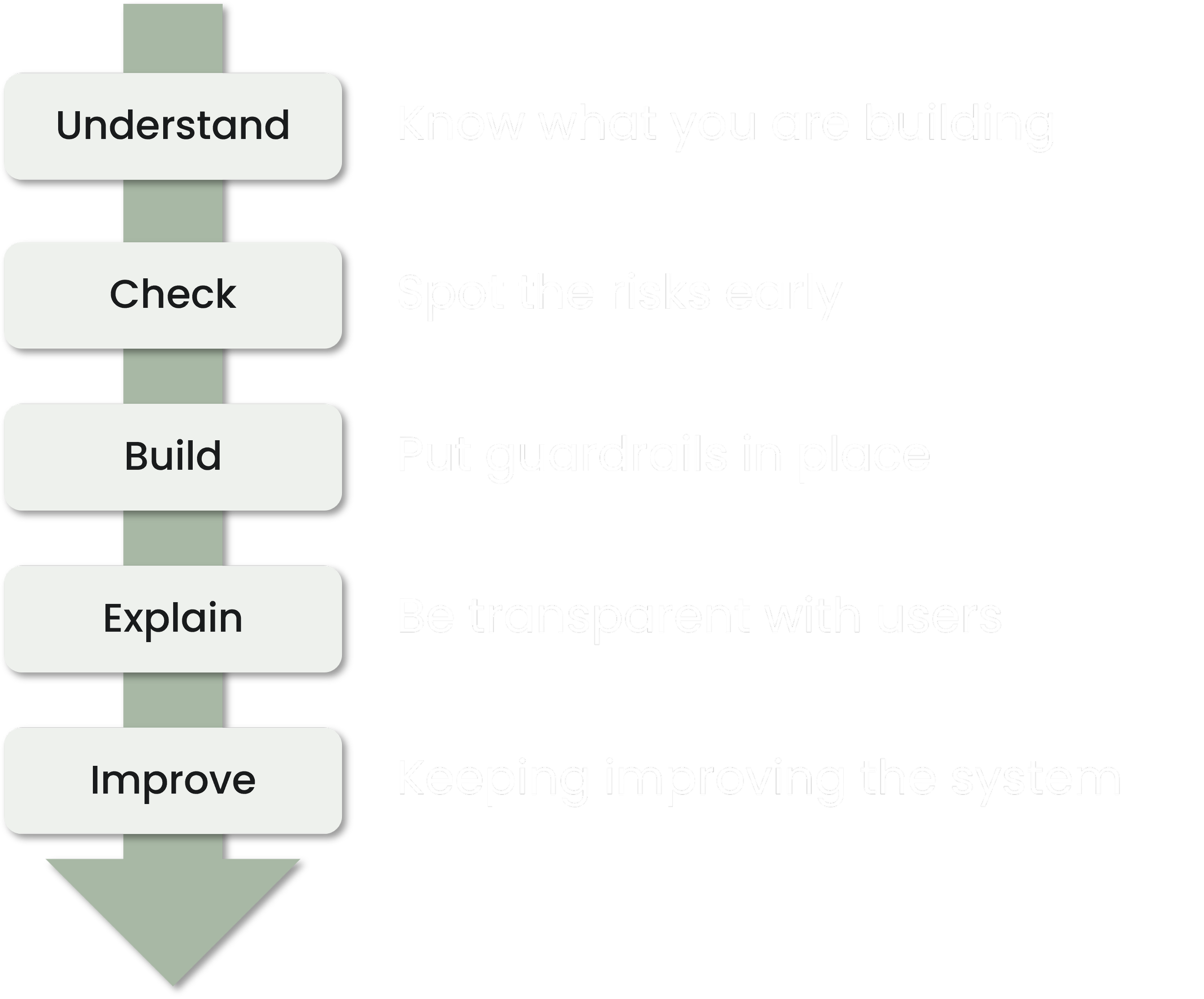
To secure AI system benefits and identify and mitigate any negative impacts, designing for Responsible AI should begin early in the planning of any AI system and continue throughout the system's lifecycle. Many AI solutions have behaved erratically in situations that weren't adequately assessed and planned for. Such behaviour can, and has, caused injury and injustice and reduces people's willingness to trust AI technology. Such adverse impacts are why it is important that when we design, develop and deploy AI systems, we assess and document their potential impacts, ensure we can measure and mitigate areas of concern as they evolve over time, be able to communicate to users and stakeholders it’s intended use and misuse and then continue to monitor, adjust and adapt to stay true to the Responsible AI guardrails originally intended through it’s lifecycle until retirement or major transition.
Whilst the majority of focus around Responsible AI is on the citizens and societies we want to protect - sustainability is attracting more focus and momentum. As AI becomes more energy‑hungry, we have a responsibility to build and use it in ways that protect our planet and preserve the resources future generations will depend on.

Responsible AI isn’t just a technical problem - and not just something for big-tech firms.
Responsible AI doesn’t fail because of the tech - it fails when it’s treated only as a tech issue.
The real risk comes from how AI is planned and deployed, which makes Responsible AI an operational discipline, not just a technology or tools discussion.
The foundational principles are the same - anyone building, investing or using AI needs to under the risks, limitations and obligations on them - there needs to be full transparency in how to use it safely - throughout it’s lifecycle.
With the introduction of the first significant legislation in the EU AI Act, many nations, governments and regulatory bodies are defining guardrails, guidance and laws to protect their citizens - all with different approaches on the what, how and when.
It’s a fast-moving topic, highly fragmented across the world - making it hard for organisations to stay up-to-date.
Organisations building, investing or using AI systems need to understand their use cases and risk classifications to ensure they adopt the most appropriate and proportionate aspects of Responsible AI practices to build trust in their brands - and ensure customers and regulators are satisfied that their AI systems bring advantage - not harm.
Responsible AI is becoming a board level priority.

Ethical Expectations
Customers, employees and investors increasingly expect transparent, fair and accountable AI — making responsible practice a core trust and reputation driver.
Cost of Business
Poorly governed AI brings real financial risk through fines, liability, operational failures and reputational damage, while mature RAI reduces exposure and supports sustainable growth.
Competitive Advantage
Early adopters gain trust, investor confidence and smoother scaling. Responsible AI maturity is becoming a differentiator in procurement and investment decisions.
Global approaches to responsible AI are still highly fragmented, with countries, industries and organisations taking different paths. This creates a patchwork of expectations that founders, teams and investors must navigate as they build and deploy AI systems.
Alongside emerging laws, many organisations rely on voluntary frameworks such as NIST and ISO/IEC 42001, as well as national or industry guidance. These provide practical ways to manage AI risks, but adoption varies widely across regions and sectors.
Adding to the complexity, there are dozens of think tanks and research institutes worldwide that are influencing and shaping AI ethics, policy and best practice. Their influence is significant, but their perspectives differ — contributing to a landscape where no single, unified approach yet exists.

Legal Must-Do’s
These are the non-negotiables.
If you are building or deploying AI systems, these are the rules you must follow - no matter your size, sector or stage.
AI systems aren’t one‑size‑fits‑all — their purpose, users, environment, and industry shape the risks and the level of obligation each one needs to address.
You must know your obligations and comply.
-
The EU AI Act is the world’s first comprehensive AI regulation. It uses a risk‑based approach to protect citizens while still supporting innovation. Like GDPR, it’s widely expected to become a global reference point for AI governance. Many countries without their own laws are already using it as the basis for their guidance and guardrails.
Because of this, organisations outside the EU are choosing to align with the Act early. Doing so provides strong evidence of responsible practice and helps future‑proof compliance as other countries introduce their own rules.
The Act defines prohibited, high‑risk, and limited‑risk AI, sets out what must be documented, and introduces new expectations for general‑purpose AI.
Small and medium‑sized organisations get some flexibility and accommodations, but the core legal obligations still apply
It also clarifies the responsibilities of every party in the AI supply chain — from developers to deployers — across all EU Member States.
-
Where countries do not yet have central legislation, many have principles-based approaches or embedded legislations within their regulators or state government rulebooks. Understanding where you AI System is being used (not developed) is important to ensure you are complying with any national or state-specific requirements.
-
AI builders and users must follow any sector‑specific rules that apply in their industry — from healthcare and finance to education and public services. Existing laws on data, fairness, safety, and accountability still apply when AI is involved. In practice, AI always inherits the regulations of the sector it operates in, and teams need to know which rules apply before they deploy.

Good Practice
Standards aren’t law or legally binding - but they are incredibly useful. They show you how to build and manage AI responsibly across the whole lifecycle.
These are technology and tools-neutral so they can apply to any AI system and use case.
You can choose to adopt these at any time- the earlier the better to scale with your growth.
-
The US-based National Institute of Standards + Technology has developed a best practice framework on how to identify, measure and reduce AI risk throughout the lifecycle of the AI systems. The guidance is intentionally flexible - it works for starts-ups, scale-ups and large enterprises - and focuses on real-world risks such as bias, security, vulnerabilities, misuse and unexpected model behaviours. NIST is widely used globally as it is technology-neutral and aligned with emerging global regulations.
-
ISO (International Organisation for Standardisation) is an independent, global body that develops voluntary international standards. IEC (International Electrotechnical Commission) prepares and publishes international standards for electrical, electronic and related technologies). Together they collaborate on many technology-related standards - including ISO/IEC 42001 for AI Management Systems.
ISO/IEC 42001 is the first international standard designed specifically for managing AI systems responsibly. It helps teams put the right processes in place for risk management, data quality, model oversight, documentation and ongoing monitoring, without dictating how the technology must be built. It is also closely aligned to the EU AI Act and NIST.
It delivers a practical structure for running AI responsibly day-to-day. This is more suited to larger organisations that may need to demonstrate stronger compliance and require a full governance framework. It’s also a costly approach to prepare and be audited which makes it cost-prohibitive and out-of-reach for some organisations.
-
There are dozens of think tanks and research institutes that are shaping Responsible AI across the world - at national, regional and global levels.
Global institutes including the Alan Turing Institute, Ada Lovelace Institute, OECD.AI and UNESCO shape the policies and standards behind Responsible AI. Their work guides how organisations build safe and transparent AI.
With many of the big-tech firms like Microsoft, Google and IBM also influencing the landscape through internal frameworks, public advocacy and participation with the standards bodies and policymakers.
Their involvement has helped influence regulations - like the EU AI Act - and best practices and global standards like NIST AI RMF and ISO/IEC 42001.

Responsible AI Coaching
We translate the emerging global standards, best practices and legislations around Responsible AI - such as EU AI Act, ISO/IEC 42001 and NIST AI RMF - into practical steps that teams can actually adopt into their rhythms and roadmaps.
We help your teams clarify what is essential versus what is optional.
From risk classification to maturity uplift and coaching, services are structured as modular building blocks that can be adopted in manageable increments, aligned to each client’s needs, priorities and readiness.
Services available for teams and organisations that build, invest or use AI systems from start-ups to scale-ups or departmental teams.
Explore what’s on offer.

Responsible AI Coaching + Support Services
Ideal for organisations wanting to embed lightweight, proportional and pragmatic Responsible AI (RAI) practices and behaviours into the lifecycle of their AI systems based on their business priorities and risk classification.
Suitable for teams of any size. Applicable to start-ups and scale-ups from Seed investment stages onwards.
Learn more about our Services are are relevant to you.